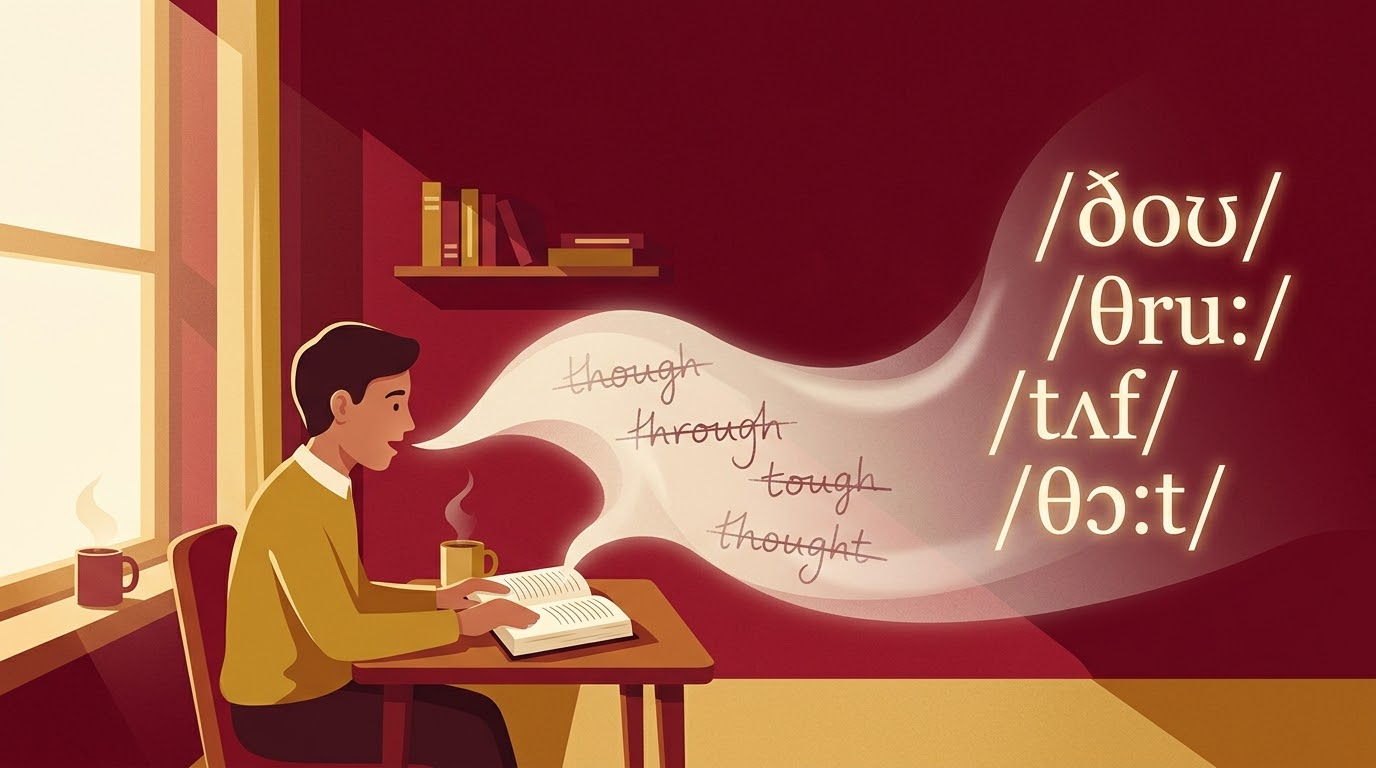
Por que o IPA importa: decodificando a pronúncia real do inglês
2026-09-09
"Though", "through", "tough" e "thought" rimam na escrita e soam completamente diferentes. A ortografia do inglês não é confiável — o alfabeto fonético internacional (IPA) é.
Referências
International Phonetic Association (1999). Handbook of the International Phonetic Association: A Guide to the Use of the International Phonetic Alphabet. Cambridge University Press.
Bassetti, B., Escudero, P., & Hayes-Harb, R. (2015). Second Language Phonology at the Interface Between Acoustic and Orthographic Input. Applied Psycholinguistics, 36(1), 1–6.
Escudero, P., & Wanrooij, K. (2010). The Effect of L1 Orthography on Non-Native Vowel Perception. Language and Speech, 53(3), 343–365.
Young-Scholten, M. (2002). Orthographic Input in L2 Phonological Acquisition: A Supplement, Not a Filter. EUROSLA Yearbook, 2, 263–285.
Best, C. T., & Tyler, M. D. (2007). Nonnative and Second-Language Speech Perception: Commonalities and Complementarities. In O.-S. Bohn & M. J. Munro (Eds.), Language Experience in Second Language Speech Learning, 13–34. John Benjamins.
Rogerson-Revell, P. (2011). English Phonology and Pronunciation Teaching. Continuum.
Quer experimentar na prática?
Crie uma conta grátis e comece a aprender com conteúdo real.